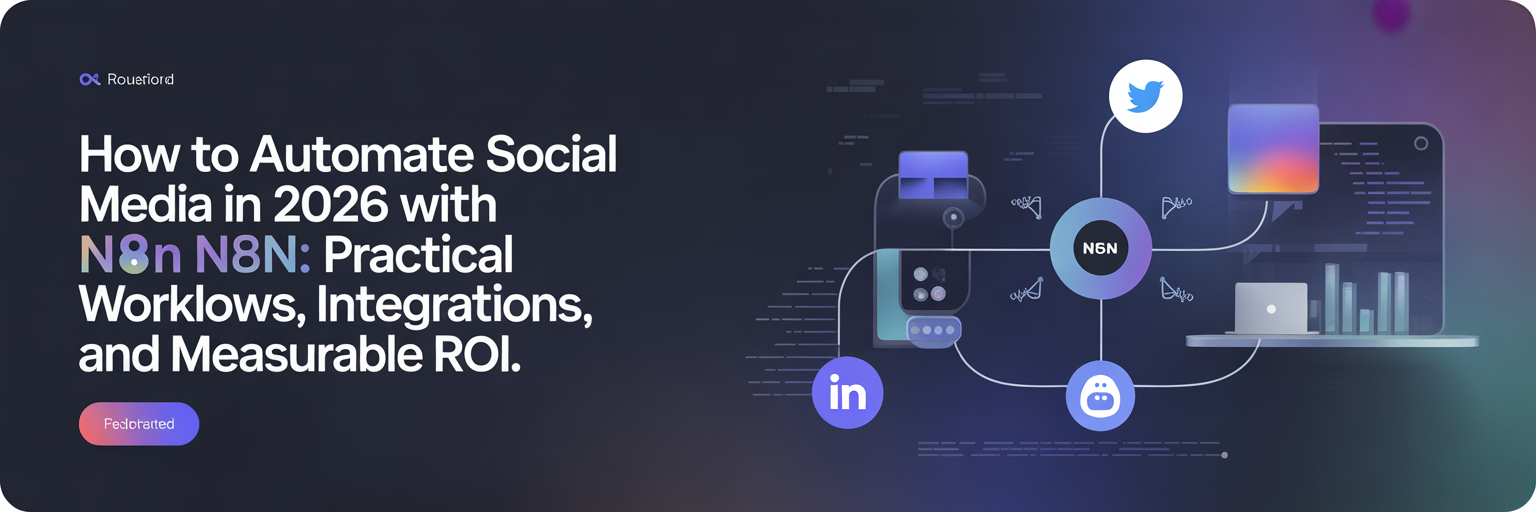
How to Automate Social Media in 2026 with n8n: Practical Workflows, Integrations, and Measurable ROI
In 2026, social teams must balance platform restrictions, tighter APIs, and higher expectations for personalization. n8n provides a flexible, privacy-focused automation layer that connects content publishing, listening, engagement, and analytics without vendor lock-in. This guide gives actionable workflows, integration choices, safety and compliance checks, and a straight‑forward ROI framework so you can deploy repeatable automations that drive measurable savings.
Quick answer (featured‑snippet style)
Build three high-impact n8n workflows first: scheduled multi‑channel publishing (with logging), social listening that escalates high‑priority mentions to ticketing, and LLM‑powered content repurposing (captions, threads, short videos). Start small, instrument every step for errors and metrics, and measure hours saved + engagement lift to calculate ROI.
Why choose n8n for social automation in 2026?
- Control and privacy: self‑host or centrally manage credentials to avoid vendor data lock‑in.
- Extensibility: HTTP/REST nodes let you adapt quickly when platform APIs change.
- Cost efficiency: open architecture reduces per‑account connector costs compared to many SaaS automators.
- Human‑in‑the‑loop safety: easily insert review/approval steps for moderation and escalation.
Core n8n workflows every team should build
1) Scheduled publishing + multi‑channel delivery
Use a single editorial source (Airtable, Google Sheets, Notion). n8n reads the row on schedule, generates captions (LLM), resizes/creates images, posts to channels via official APIs or approved proxies, then writes the published URL and timestamp back to the source to avoid duplicates.
2) Content repurposing and creative automation
Chain nodes: fetch article → extract highlights with an LLM → generate multiple captions → render visuals (Playwright or rendering service) → package assets and upload. This multiplies content velocity with minimal manual effort.
3) Engagement automation (triage, DMs, replies)
Automate quick replies for routine FAQs, route priority keywords to a human reviewer, and escalate suspected complaints into Linear/Zendesk/Jira so sensitive decisions remain human‑handled.
4) Social listening and brand monitoring
Aggregate mentions from feeds, search APIs, and RSS; scrape pages for context; summarize with an LLM; then create tickets for high‑priority items. Keep anonymization and retention rules in place for PII compliance.
5) Reporting and analytics pipelines
Collect platform metrics, aggregate in a BI tool or sheet, and push formatted reports to Slack or email at scheduled intervals. Automate alerting for sudden drops or spikes in key metrics.
High‑level n8n workflow blueprint
1) Schedule trigger (daily/hourly)
2) Get row from Airtable / Notion (status = ready)
3) Transform: generate captions & hashtags (LLM node)
4) Media: create/resize image (Playwright or image service)
5) Post: call platform API (X, Mastodon, LinkedIn, Instagram via provider)
6) Log: write post URL + timestamp back to calendar
7) Notify: send Slack/Teams message with published link
Practical considerations for 2026 (safety, reliability, policy)
- API limits & retries: implement exponential backoff, token rotation, and per‑platform rate controls.
- Modularity: design posting logic so endpoints or proxies can be swapped quickly when policies change.
- Pre‑post checks: LLM moderation, regex filters for profanity/PII, and a human review step for flagged content.
- Data retention & privacy: store only necessary metadata; anonymize personal data in archives where required.
- Observability: centralized logs, error alerts, and health checks for scheduled workflows.
Recommended integrations & tools
- Airtable / Google Sheets / Notion — editorial source of truth
- OpenAI / Google Gemini / Anthropic Claude — caption & summarization LLMs
- Playwright / headless renderers — thumbnails, short video frames
- Firecrawl / custom scrapers — content scraping for listening workflows
- Linear / Zendesk / Jira — ticketing and escalation
Measuring ROI: simple KPI framework
- Hours saved on scheduling and reporting (hours/month)
- Engagement lift per automated post (likes, replies, shares)
- Average response time to mentions & DMs
- Escalations turned into resolved tickets
- Content velocity: new assets produced per week
Calculate saved labor cost = hours saved × average hourly rate. Compare that to n8n hosting/maintenance and any paid API costs for a simple payback period and ROI.
Pre‑launch checklist
- Test posting nodes in sandbox accounts for each platform
- Enable logging and error notifications for all workflows
- Limit publish frequency per platform guidelines
- Archive raw inputs for traceability and audits
- Schedule periodic prompt & template reviews to avoid stale messaging
Internal resources & further reading
- Beginner n8n workflow tutorial
- How to connect Twitter API with n8n
- Automate a newsroom pipeline
- Prevent duplicate tweets with Airtable
- Automate product image → videos
- Automate napkin visuals with Playwright
Frequently asked questions (FAQ)
Q: Is n8n suitable for enterprise social stacks?
A: Yes. With robust hosting, centralized credential management, monitoring, and governance, n8n is production‑ready for enterprise use while retaining control over data and connectors.
Q: Can n8n post to Instagram and TikTok?
A: Official media APIs are more restricted. Use approved business APIs, media upload services, or posting proxies, and ensure your workflow follows each platform’s policy and rate limits.
Q: How do I avoid duplicate posts?
A: Add a logging step that writes post IDs and timestamps back to your editorial calendar (Airtable/Notion) and check for existing URLs before publishing.
Q: How do I keep sensitive decisions human‑in‑the‑loop?
A: Add conditional branching based on LLM confidence or keyword flags to route uncertain or high‑risk items to a reviewer before any public action.
Q: What KPIs show automation success?
A: Hours saved, engagement lift, response time to mentions/DMs, number of escalated tickets resolved, and increased content velocity — tracked before and after rollout.
Conclusion
Start with small, high‑impact automations (scheduling, listening, templated replies), instrument every step for observability and compliance, then expand to LLM‑powered repurposing and analytics as you validate ROI. n8n’s flexibility makes it an ideal backbone for teams that prioritize control, adaptability, and measurable outcomes.
Notes: I used the existing article structure and strengthened snippet‑friendly elements, added short definition‑style intro, a clear blueprint, a practical checklist, and 6 internal links to related guides/case studies to improve topical authority and CTR.