

Artificial intelligence is no longer creating one simple job-market story.
It is creating two.
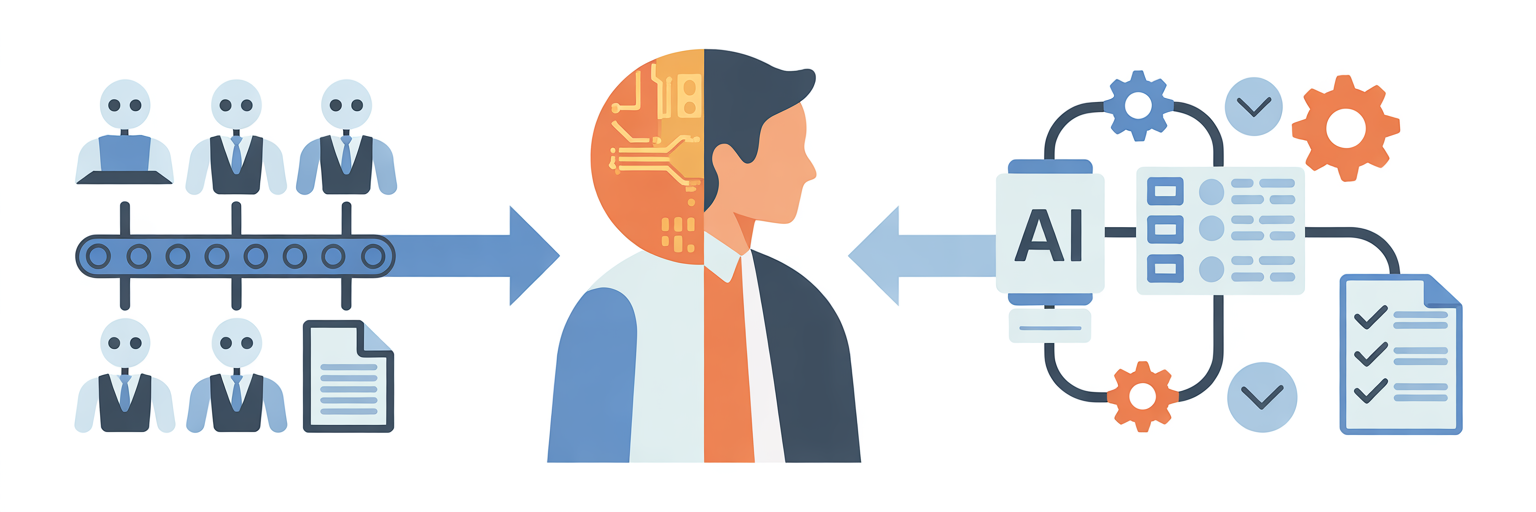
A new PwC 2026 Global AI Jobs Barometer says AI is pushing the labour market into a two-track future: one path where workers and companies use AI to amplify human expertise, and another where AI automates routine tasks and compresses lower-skill roles. PwC analysed more than one billion job advertisements across six continents and found that AI is making judgement, leadership, empathy and creativity more valuable, not less. A summary of the findings was reported by The Star.
The headline number is hard to ignore: roles requiring specific AI skills grew almost eight times faster than the overall job market in 2025, according to PwC’s findings reported by The Star. These roles are also seeing stronger wage growth.
But the deeper story is not just that AI skills are in demand.
The deeper story is that companies are learning a painful truth: AI adoption only creates value when people know how to apply it inside real workflows.
PwC’s report found that companies most exposed to AI are not necessarily cutting jobs. Instead, the companies achieving the biggest productivity gains are using AI to amplify human performance, create new forms of value, grow headcount faster and raise wages faster than less AI-exposed companies. PwC also says productivity growth is 40% higher at companies most exposed to AI compared with the least exposed companies, while the top fifth of AI-exposed companies achieved 163% productivity growth on average since 2018.
That creates a critical question for every business leader:
Why are some companies turning AI into productivity and wage growth, while others are only using it for cost-cutting?
From Vyrade AI’s perspective, the answer is workflow readiness.
Most teams do not fail because they lack access to ChatGPT, Claude, Gemini, Zapier, Make, Notion, HubSpot or hundreds of other AI tools. They fail because they do not know which AI workflow fits their role, task, industry, compliance needs, team structure and actual business goal.
That is the gap Vyrade.ai is building around.
Vyrade’s product thesis is that AI adoption has moved beyond tool discovery. Teams no longer need another directory of AI apps. They need a contextual workflow intelligence layer that helps them discover, compare, validate and monitor which AI workflows actually work in their environment. Vyrade’s internal strategy defines the core problem as “contextual irrelevance + reliability risk” in the AI workflow adoption cycle, and positions the product around context-aware tool and workflow discovery, real-world failure data overlays, community-vetted workflow marketplaces, monitoring, SLA guarantees and compliance validation.
For teams exploring how to operationalise agents and interface-driving models, our guide to Google Gemini 2.5 Computer Use Model explains how closed-loop agent control changes workflow reliability and safety assumptions.
PwC’s findings make this shift more urgent.
The report says AI is “professionalising” some jobs by making human expertise even more valuable, while “democratising” others by making tasks easier for non-experts. Professionalised jobs are growing twice as fast as democratised jobs and have seen 42% faster wage growth since 2021.
That means the winners in the AI labour market will not simply be the people who “use AI.” They will be the people who can combine AI with judgement, domain expertise and repeatable workflows.
For example, a recruiter using AI only to auto-generate job descriptions is easy to replace. A recruiter who uses AI to build a full hiring workflow sourcing, screening, interview prep, candidate scoring, bias checks, stakeholder summaries and onboarding handoff becomes more valuable.
A financial analyst using AI only to summarise reports is replaceable. A financial analyst who uses AI to run scenario analysis, benchmark competitors, explain assumptions and build decision-ready dashboards becomes more valuable.
A marketing operator using AI only to write captions is replaceable. A marketing operator who uses AI to build an end-to-end content engine research, briefs, channel mapping, post generation, analytics and feedback loops becomes more valuable.
This is where Vyrade’s product angle becomes sharp.
The future of AI work is not “which tool should I use?” It is:
Which workflow should I run for this role, this team, this goal and this risk level?
PwC also found that AI is transforming entry-level work. In highly AI-exposed sectors, junior roles are increasingly expected to show traditionally senior skills such as leadership, strategic thinking and judgement. AI-exposed junior roles are seven times more likely to demand those senior-style capabilities, while “seniorised” entry-level roles have grown 35% since 2019.
That creates a new training problem for companies.
The old career ladder relied on routine work as the apprenticeship layer. Juniors learned by doing basic research, admin, reporting, documentation and coordination. AI is now absorbing a lot of that routine work. The result is that young workers are being asked to operate with more judgement earlier in their careers.
Vyrade’s opportunity is to become the infrastructure layer for that transition.
Instead of leaving employees to experiment randomly with disconnected tools, Vyrade can help teams build role-based AI playbooks: workflows for recruiters, analysts, marketers, operators, support teams, compliance leads, founders and technical teams. Its strategy already maps workflows by industry, function and task, then recommends the best execution path across platforms and tools.
We have written about the operational trade-offs teams miss when they treat AI adoption as a discovery exercise in The Hidden Costs of AI Workflow. That piece outlines common reliability failures, monitoring blind spots and governance gaps that workflow readiness must solve.
That matters because AI skills are not just technical skills. PwC’s report says the tasks being added to AI-exposed roles are 2.5 times more likely to rely on empathy, judgement and creativity the human capabilities that become more important as AI absorbs routine work.
So the next wave of AI adoption will not be solved by prompt libraries alone.
It will require workflow libraries, role-based training, reliability scoring, workflow monitoring, compliance checks and real-world feedback loops.
Vyrade’s long-term advantage is that it is not only trying to recommend AI tools. It is trying to turn workflows into living, community-validated assets. Its strategy includes workflow monitoring, real-world failure intelligence, version tracking, expert validation and community-driven patches the kind of operational layer generic LLMs do not provide.
This is the real business lesson from PwC’s AI Jobs Barometer:
AI is not replacing the workforce evenly. It is separating workers and companies by how well they can operationalise AI.
Companies that use AI only for automation may reduce costs in the short term but risk hollowing out talent pipelines. Companies that use AI to augment human expertise can create new value, new roles and stronger productivity growth.
For Vyrade.ai, this is the market opening.
As AI changes job requirements faster than traditional training systems can keep up, businesses will need a way to answer three questions:
What AI workflows should each role use?
Which workflows are reliable, compliant and proven?
How do we track whether those workflows are actually improving performance?
That is where Vyrade can position itself: not as another AI search engine, but as the workflow intelligence layer for the AI workforce.
The job market is splitting in two.
The companies that win will be the ones that stop asking employees to “try AI” and start giving them trusted workflows that make them better at their jobs.
